Manual vs Automatic Sorting
Many logistics operators still question whether automation is worth the investment. It may seem that employees can continue managing the workload as they always have. However, the reality inside a warehouse often looks very different: tired employees, piles of unsorted parcels and recurring customer complaints about delays.
When Manual Sorting Still Works
For smaller warehouses processing up to 1,000 shipments per day, manual operations may still be justified. If the product range is straightforward and peak loads are moderate, several experienced employees can manage the process without complex equipment.
Clear instructions and a reasonable work schedule are essential. In such cases, automation may be an unnecessary luxury.
However, the operational limit can be reached quickly. Once daily volumes exceed 2,000–3,000 parcels, manual sorting starts to become less reliable. Employees become tired, concentration drops and the number of errors increases. Every incorrectly sorted box can result in a delayed delivery, a product return and lost revenue.
Challenges of Manual Sorting in a Warehouse
Manual operations create several significant challenges:
- High dependence on the human factor. Even the most experienced employee can overlook a barcode or confuse a sorting destination towards the end of a shift.
- Ongoing labour costs. Companies need to hire additional staff during peak seasons, pay overtime and manage high employee turnover.
- Physical strain. Constant movement around the warehouse, lifting boxes and working at a fast pace quickly become exhausting. The result is sick leave, fatigue-related errors and difficulties in scaling the business.
As a company grows, manual sorting becomes a constraint. New customers arrive, volumes increase and the warehouse can no longer keep up. Queues, night shifts and operational disorder begin to affect even long-standing business relationships.
Benefits of Automation and Practical Examples
Automated systems can fundamentally change warehouse operations. They work consistently around the clock, do not become tired and make very few errors.
Key benefits include:
- a significant increase in processing speed, from several thousand to tens of thousands of shipments per hour;
- a sharp reduction in errors, with accuracy reaching 99.9%;
- lower labour requirements, as fewer employees are needed to maintain the same productivity;
- easy scaling during seasonal peaks without large-scale recruitment;
- fast integration with WMS, providing full control over warehouse processes.
UIS solutions have already demonstrated their effectiveness in implemented projects.
TiltTray efficiently handles smaller parcels, directing them to the required destinations at speeds of up to 1.25 m/s. Switch Sorter processes heavier shipments weighing up to 30 kg, including boxes of different shapes and sizes.
Put to Light supports operations in the picking area. Light indicators show employees where each item should be placed, allowing orders to be picked several times faster. Together with a modern WMS, the entire line operates as one coordinated system.
Payback Period for Automated Warehouse Systems
Many companies are concerned about the high initial cost of automation. However, calculations show that a properly selected solution can pay for itself within several years.
The exact period depends on the type of business, operational volumes and the equipment selected. Savings on labour costs, fewer processing errors and faster inventory turnover help recover the investment.
Automation also strengthens the company’s reputation. Customers receive faster and more accurate deliveries, while the business can plan future growth with greater confidence.
Moving from manual to automated sorting is not simply an equipment purchase. It is an investment in the future of the business.
Companies that make the transition at the right time benefit from greater stability, higher speed and the ability to take on new large-scale contracts. When a warehouse can no longer keep pace with growing volumes, it is time to consider modern sorting equipment.
Manual or Automated Sorting: Which Should You Choose?
Manual sorting remains a practical option for smaller warehouses with limited shipment volumes and a stable workload. It does not require major upfront investment and is suitable for companies at an early stage of development.
However, as volumes grow, the capacity of manual sorting is quickly exhausted, making it increasingly difficult to maintain consistent service quality.
TiltTray and Switch Sorter systems, Put to Light systems and a modern WMS help maintain high productivity regardless of the season. They reduce the impact of the human factor and allow warehouses to scale without continuously expanding their workforce.
The choice between manual and automated sorting depends primarily on current volumes and the company’s growth plans. For a business focused on expansion, automation is not simply an expense but a tool that supports stable warehouse operations for years to come.

Inventory Management in a Company: Methods, Strategies, and Optimization Systems
Inventory management directly affects how efficiently an enterprise operates. When the right products are always available and capital is not tied up unnecessarily on warehouse shelves, production continues without disruption, sales remain stable and avoidable costs are reduced.

Key KPIs in Logistics: How to Improve the Efficiency of Warehouse Operations and the Transportation System
Imagine a warehouse that operates around the clock, vehicles that depart exactly on schedule and customers who award five stars even for urgent deliveries in heavy traffic. It may sound ideal, but this is how companies operate when they learn to manage logistics using the right KPIs.
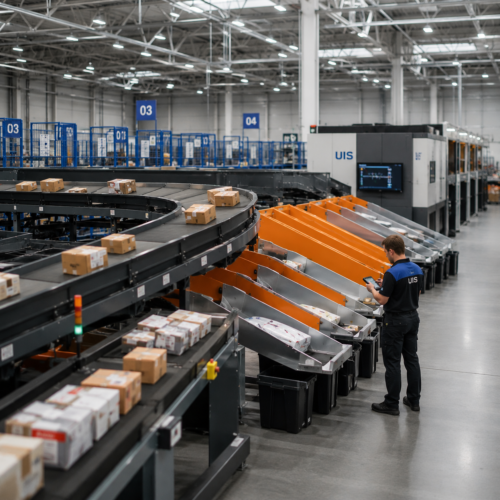
How to Choose a Sorting System for a Logistics Operator
As shipment volumes grow and customers expect increasingly faster delivery, manual sorting becomes a bottleneck. Choosing the wrong system can slow down warehouse operations, increase staff workload and lead to additional costs.

UIS Named Business of the Year 2026
Every year, Ukrainian Business Award recognizes companies that demonstrate strong results, contribute to the development of their industries, and create practical value for the market. This year, UIS is among the award recipients.
 Україна
 Great Britain
 Česká republika
 Қазақстан
 Deutschland
 Polska
 Oʻzbekiston
 Тоҷикистон
 España
 Argentina
 México
 Perú
Perú