Inventory management directly affects how efficiently an enterprise operates. When the right products are always available and capital is not tied up unnecessarily on warehouse shelves, production continues without disruption, sales remain stable and avoidable costs are reduced.
With fluctuating demand and increasingly complex supply chains, an effectively designed inventory management system is no longer simply convenient. It is a genuine competitive advantage.
What Is Inventory Management in an Enterprise?
Inventory management involves the continuous monitoring, analysis and regulation of raw materials, components and finished goods. It covers the entire cycle, from procurement to dispatching orders to customers.
The main objective is to ensure that the required items are available at the right time while minimising storage costs.
Inventory can be divided into several categories:
- raw materials and components: the basis of production;
- work in progress: goods that are currently being assembled or manufactured;
- finished goods: products awaiting dispatch;
- auxiliary materials: items used for equipment repair and maintenance.
Each inventory category requires individual control to prevent both shortages and excess stock.
Why Effective Inventory Management Matters
Excess inventory ties up working capital, occupies warehouse space and increases the risk of damage or obsolescence.
Insufficient inventory can lead to production stoppages, missed deadlines and lost customers.
A well-designed system helps businesses:
- maintain an optimal balance;
- reduce costs;
- improve service levels.
Companies that focus on inventory management report higher turnover, lower losses and more accurate demand forecasting. As a result, their financial position improves and the business becomes more resilient to external fluctuations.
Key Inventory Management Methods in Logistics
Several proven approaches are widely used in practice. The right choice depends on the industry, operational volumes and the nature of demand.
ABC Analysis
ABC analysis divides items according to their importance and value:
- Category A: high-profit items that require strict control;
- Category B: items of medium importance;
- Category C: lower-cost items that require minimal attention.
The method allows businesses to focus their resources on the most critical items.
Just-in-Time System — JIT
The Just-in-Time system follows a simple principle: materials arrive exactly when they are required for production.
There is no need to maintain unnecessary warehouse stock—only the inventory expected to be used in the near future is stored.
This significantly reduces storage costs but requires highly reliable suppliers and a very accurate understanding of future demand.
Economic Order Quantity — EOQ
The EOQ method calculates an optimal purchasing volume by considering the costs associated with ordering, storage and shortages.
The formula helps businesses avoid both frequent small deliveries and excessively large batches that remain in storage for long periods.
Safety Stock
Safety stock creates a reserve for unexpected situations, such as delayed deliveries or a sudden increase in demand.
FIFO — First In, First Out
FIFO ensures that older batches are used first. This is especially important for goods with a limited shelf life.
Warehouse Inventory Management
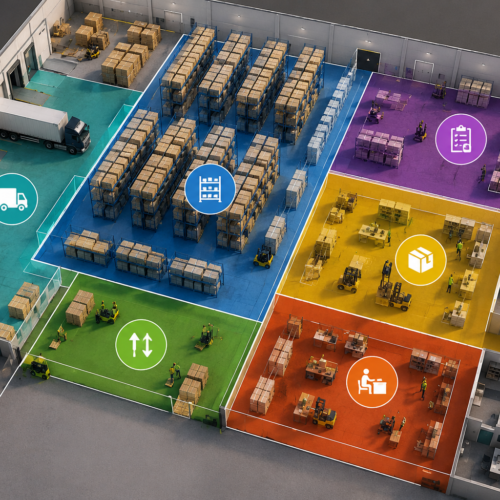
Warehouse inventory management is the foundation of the entire system.
Modern warehouses use location-based storage, barcode identification and automated systems that record every movement in real time. This reduces picking errors and accelerates order processing.
Regular audits and reorder points help maintain accurate stock balances. Zoning goods according to demand frequency reduces the time required for search and picking.
Seasonality and market trends should also be considered so that inventory volumes can be adjusted at the right time.
Inventory Management Systems
Inventory management systems automate routine processes and provide accurate data for decision-making. They integrate with accounting software, sales systems and logistics solutions, creating a unified information environment:
- WMS solutions specialise in warehouse operations, including receiving, placement, picking and dispatch;
- ERP systems cover the full cycle, from procurement planning to sales analysis;
- cloud platforms provide access from any location and support scaling as the business grows.
Automation makes it possible to track expiry dates, serial numbers and batches. Many products also offer predictive analytics based on historical data and external factors, helping businesses anticipate changes in demand.
Optimisation Strategies
Inventory optimisation requires an integrated approach.
Inventory turnover analysis shows how many times stock is renewed during a particular period. A decline in this indicator may signal operational problems.
Implementing VMI — Vendor Managed Inventory — means transferring part of the inventory control process to suppliers. They monitor stock levels and replenish inventory independently.
Reverse logistics organises product returns and recycling, reducing losses.
An omnichannel approach combines inventory from online and offline stores, allowing orders from any channel to be fulfilled quickly.
Regular assortment reviews help eliminate slow-moving and obsolete stock. Combining ABC analysis with EOQ and safety stock provides the most balanced result.
Benefits of Effective Inventory Management
When inventory management is properly organised, revenue can grow steadily while the required products remain available.
Storage and handling costs decrease, together with waste volumes and disposal costs. Customers receive their orders faster and without unpleasant surprises, significantly increasing their loyalty.
Demand forecasting also improves, while the risk of supply chain disruptions decreases.
Capital that was previously tied up in warehouse stock becomes available and can be invested in business development.
There is also an environmental benefit: fewer unnecessary goods, less waste and more responsible use of resources.
Development Trends
Today, enterprise inventory management is closely connected with advanced technologies:
- artificial intelligence analyses large volumes of data and recommends optimal solutions for stock replenishment and distribution;
- the Internet of Things — IoT — enables real-time inventory tracking through sensors and tags;
- robotics and automated systems significantly accelerate receiving, picking and dispatch processes in modern warehouses;
- blockchain increases transparency throughout the supply chain by making individual operations verifiable.
3D printing allows businesses to manufacture required parts and components on demand, significantly reducing the need for large warehouse reserves.
Sustainable practices are becoming a standard requirement, with a growing focus on recycling, waste reduction and environmentally responsible logistics.
Solutions developed by the Ukrainian company UIS play an important role in this transformation.
UIS products for inventory management systems combine advanced analytics, user-friendly dashboards and integration with existing accounting systems.
UIS platforms help businesses automate demand forecasting, monitor inventory turnover and respond quickly to market changes, making inventory management more flexible and predictable.
How to Implement Changes
The process should begin with a thorough assessment of the current situation, including stock balances, turnover and the structure of costs.
The next step is to select suitable methods and tools based on the specific requirements of the enterprise.
A pilot project within one operational area or warehouse makes it possible to test the approach and introduce adjustments before full-scale implementation.
Employee training and high-quality data integration are also important stages. UIS solutions simplify this process through an intuitive interface and ready-to-use integration modules.
The inventory management process within an enterprise is continuous and directly affects the company’s competitiveness.
The right combination of proven methods, modern strategies and reliable optimisation systems, including UIS products, transforms potential risks into opportunities for sustainable development and increased profitability.



 Україна
 Great Britain
 Česká republika
 Қазақстан
 Deutschland
 Polska
 Oʻzbekiston
 Тоҷикистон
 España
 Argentina
 México
 Perú
Perú