Analysis of Warehouse Performance Metrics and Methods for Evaluating Them
Today, a warehouse is not just a place to store goods, but a full operational hub that affects order processing speed, shipment accuracy, and ultimately customer satisfaction. That is why warehouse analysis is no longer just a formality – it is an ongoing business task.
To understand how efficiently a warehouse operates, you need clear benchmarks and reliable data. This is where warehouse KPIs help: they provide a measurable view of actual performance rather than subjective assessments.
Collecting warehouse performance metrics is not enough, they also need to be interpreted correctly. Otherwise, the numbers remain just statistics that do not answer the main question: where resources are being wasted and how to fix it.
Key Warehouse KPIs and Their Role in Management
There is no one-size-fits-all set of metrics, but there are key warehouse KPIs that are used by most companies and give a broad view of how efficient warehouse processes are.
These metrics typically include:
- order processing speed;
- picking accuracy;
- error rate;
- inventory turnover;
- staff utilization.
This data helps identify where delays occur, which operations require optimization, and how evenly the workload is distributed.
Key performance indicators help answer several important questions:
- Is the warehouse handling the current volume?
- Where are the bottlenecks in the process?
- How efficiently are resources being used?
It is particularly important that KPIs make it possible to compare results over time, which helps companies not only assess the current situation but also tracking changes after implementing new solutions
How to calculate warehouse efficiency and what to consider
Assessing and improving warehouse efficiency depends on regular data analysis and comparing it across different time periods. It is important to track how metrics change over time, comparing them with shifts in workload, seasonal fluctuations, and internal operational changes. This means looking not only at the speed of operations and the accuracy of order fulfillment, but also to order processing costs and inventory turnover. This approach helps to gain a deeper understanding of exactly which factors influence the results and to identify areas for further optimization.
Implementing Warehouse KPIs and the Role of Automation
Implementing warehouse KPIs is a process that requires a robust system for data collection and analysis. If data is collected manually or irregularly, it quickly becomes outdated and ceases to be useful.
That is why process automation plays such an important role. Solutions from Ukrainian Intelligent Systems (UIS) not only record warehouse operations but also create a unified digital management environment.
UIS’s WMS provides full control over warehouse processes: from receiving and storing goods to order picking and shipping. The system automatically collects and updates KPI data, reduces the impact of human error, and improves accounting accuracy.
Additionally, the UIS WMS allows you to track staff workload, optimize movement routes within the warehouse, and accelerate operations through well-defined algorithms. This is particularly important as volumes grow or logistics become more complex.
As a result, warehouse KPIs stop being static numbers in reports and become an operational management tool that helps quickly identify bottlenecks, improve process efficiency, and make informed decisions based on real-time data.
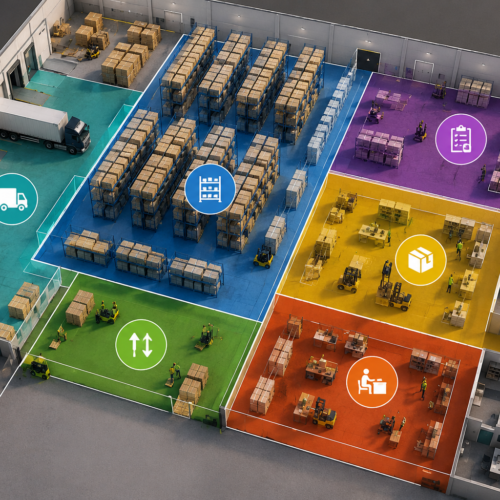
Warehouse Zoning: Efficient Space Planning
A warehouse can occupy thousands of square meters and still operate more slowly than a smaller facility if there is chaos inside. Proper space organization directly affects order processing speed, company costs, and employee convenience.

Dark Store: What It Is and How It Works
Online stores are growing, and customer expectations are rising with them. People are no longer willing to wait several days or tolerate mistakes in their orders.

How to Automate Order Picking for an Online Store
Order volumes are growing, and customer expectations are rising with them. While a small online store may once have managed with a few employees and simple inventory tracking, manual processes start slowing operations down as volumes increase.

Conducting a Warehouse Inventory: A Comprehensive Guide
Even a well-organized warehouse can gradually lose inventory accuracy if product movement is not monitored regularly. Receiving errors, stock mismatches, incorrect putaway, and losses during picking accumulate over time and affect not only system balances but also the company’s financial performance.
 Україна
 Great Britain
 Česká republika
 Қазақстан
 Deutschland
 Polska
 Oʻzbekiston
 Тоҷикистон
 España
 Argentina
 México
 Perú
Perú