Conducting a Warehouse Inventory: A Comprehensive Guide
Even a well-organized warehouse can gradually lose inventory accuracy if product movement is not monitored regularly. Receiving errors, stock mismatches, incorrect putaway, and losses during picking accumulate over time and affect not only system balances but also the company’s financial performance. Warehouse audits have long been a standard part of warehouse management, not just a formal procedure.
Warehouse inventory gives companies a clear view of the actual state of stock, helps identify weak points, and shows which processes need improvement. Properly organized control helps detect discrepancies and improve logistics operations as a whole.
Why Regular Stock Checks Are Necessary
Many companies think about data reconciliation only before reporting periods or after serious problems have already appeared. In practice, control should be regular.
A warehouse audit helps to:
- identify shortages and surplus stock;
- check inventory accuracy;
- reduce errors during order picking;
- detect problem storage areas;
- evaluate employee performance;
- avoid accumulation of slow-moving stock.
Regular checks and a proper warehouse inventory procedure show how effectively internal processes are organized. If discrepancies appear constantly, the cause is usually connected with the way operations are managed.
Types of Warehouse Inventory
The type of check depends on business tasks and the specifics of the logistics facility.
The main types of inventory checks include:
- full inventory: all items are checked;
- selective inventory: separate product groups are checked;
- scheduled inventory: carried out according to a plan;
- unscheduled inventory: conducted when losses are suspected;
- cycle counting: small checks performed without stopping operations.
Large facilities often use cycle counting to keep data up to date without interrupting daily workflows.
How to Conduct a Warehouse Inventory
Any inventory check begins with preparation. If employees do not understand the procedure and storage zones are organized chaotically, the results will be inaccurate.
Preparing the Warehouse Area
Before starting, it is important to:
- identify or remove unlabeled items;
- check labeling;
- clear aisles;
- complete open operations;
- record data in the accounting system.
The better the space is organized, the faster the reconciliation process will be.
Counting Products
The next stage is comparing the actual quantity with the accounting data. At small facilities, this can be done manually, but with larger volumes, this approach takes too much time.
Warehouse inventory automation speeds up the process and reduces the number of errors. Data collection terminals, barcode scanners, and WMS systems simplify reconciliation and allow teams to work without long operational downtime.
UIS implements such solutions, helping companies conduct checks without downtime and overloading staff.
Analyzing Discrepancies
After counting, the system shows discrepancies between actual stock and accounting data. At this stage, it is important to identify the cause of the problem.
Most often, discrepancies are related to:
- receiving errors;
- incorrect putaway;
- stock mismatches;
- late write-offs;
- losses during picking;
- employee inattention.
If such situations repeat regularly, the company should review the organization of its logistics processes.
Why Manual Inventory Audits Lose Efficiency
Manual counting is still used at small facilities, but as volumes grow, it starts to slow down operations.
During such checks:
- employees are distracted from their main tasks;
- the risk of errors increases;
- operations have to be paused;
- data processing takes a lot of time.
An automated approach helps avoid these problems. WMS records product movement in real time, data collection terminals speed up reconciliation, and analytics tools help quickly identify problem areas.
How Automation Changes Warehouse Processes
Warehouse logistics requires constant tracking of every product movement. Digital solutions help to:
- reduce checking time;
- reduce the influence of the human factor;
- conduct reconciliation without stopping processes;
- identify discrepancies faster;
- improve inventory accuracy.
UIS implements logistics management systems that help conveniently control stock balances, product movement, and employee work in a single digital environment.
How Inventory Affects Profit
Errors rarely look critical at first, but small losses gradually turn into serious expenses: unnecessary purchases, returns, shortages, and supply delays.
The more accurate the inventory data, the easier it is for a company to control stock, plan supplies, and manage expenses. A properly organized inventory check helps make logistics transparent, stable, and predictable.
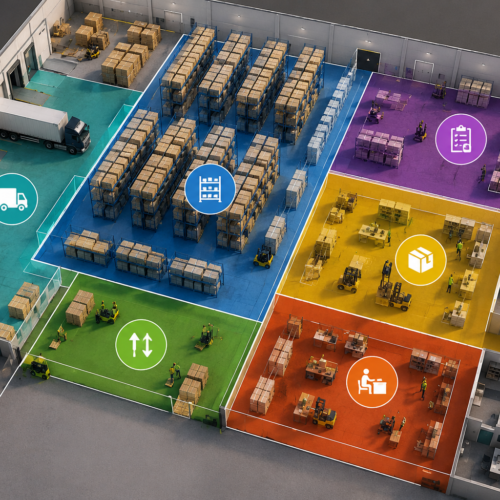
Warehouse Zoning: Efficient Space Planning
A warehouse can occupy thousands of square meters and still operate more slowly than a smaller facility if there is chaos inside. Proper space organization directly affects order processing speed, company costs, and employee convenience.

Dark Store: What It Is and How It Works
Online stores are growing, and customer expectations are rising with them. People are no longer willing to wait several days or tolerate mistakes in their orders.

How to Automate Order Picking for an Online Store
Order volumes are growing, and customer expectations are rising with them. While a small online store may once have managed with a few employees and simple inventory tracking, manual processes start slowing operations down as volumes increase.

Automation of Warehouse Logistics Processes
Warehouse logistics is one of the most resource-intensive areas of business. Profitability is affected by many factors, including inventory errors, order processing delays, and inefficient use of resources.
 Україна
 Great Britain
 Česká republika
 Қазақстан
 Deutschland
 Polska
 Oʻzbekiston
 Тоҷикистон
 España
 Argentina
 México
 Perú
Perú