Automation of Warehouse Logistics Processes
Warehouse logistics is one of the most resource-intensive areas of business. Profitability is affected by many factors, including inventory errors, order processing delays, and inefficient use of resources. That is why logistics process automation is becoming a strategic tool for companies that aim to grow, improve stability, and gain better control over operations.
Why Logistics Automation Is Necessary
Today, logistics automation is not just a trend. It is a response to real market challenges, including:
- growing order volumes;
- increasingly complex supply chains;
- shortages of qualified staff;
- higher customer expectations for speed and accuracy.
Companies that ignore these changes face rising costs and declining competitiveness.
What Warehouse Logistics Automation Covers
Warehouse logistics automation covers all key processes, including:
- receiving and inventory tracking;
- location-based storage;
- inventory management;
- order picking;
- shipment and delivery control.
Modern systems, such as WMS, help manage these operations within a single digital environment, providing visibility and control.
Benefits of Warehouse Logistics Automation
Improved Operational Accuracy
Automation reduces the impact of human error during data processing:
- fewer mistakes occur;
- losses and mis-sorting incidents are reduced;
- inventory accuracy improves.
Faster Operations
The system optimizes the movement of goods and employee routes:
- order picking time is reduced;
- receiving and shipment become faster;
- warehouse throughput increases.
Optimized Use of Resources
Optimization of logistics processes within a company is achieved through:
- efficient task distribution;
- reduced workload on staff;
- more efficient use of warehouse space.
Visibility and Control
Management gets access to real-time data, including:
- order statuses;
- goods movement;
- employee performance.
This makes it possible to respond quickly to changes and make informed decisions.
Cost Reduction
Automation of the logistics department helps:
- reduce operational costs;
- decrease the number of returns;
- improve overall work efficiency.
Implementation Specifics for Industrial Enterprises
Warehouse logistics automation in industrial enterprises has its own specifics:
- the need to integrate with production systems;
- consideration of the specifics of raw materials and finished goods;
- the need to handle large volumes and different types of cargo.
Under these conditions, solution flexibility and scalability are especially important.
How to Set Up Automation in a Logistics Department
To understand how to set up automation in a logistics department, it is important to follow a step-by-step approach:
- Analyze current processes — identify bottlenecks, errors, and areas where resources are being lost.
- Set clear goals — for example, speeding up order processing, reducing costs, or improving inventory accuracy.
- Choose the right solutions — select suitable systems, such as WMS, TMS, ERP, and the necessary equipment.
- Implement the system and train employees — prepare staff to work with new tools and processes.
- Monitor and optimize — after launch, analyze performance and refine processes where needed.
The Role of Technology in Automation
Modern warehouse automation solutions include:
- warehouse management systems (WMS);
- barcode and RFID technologies;
- robotic systems;
- order picking and fulfillment systems;
- sorting systems;
- analytics tools.
Together, these technologies make logistics processes more flexible, visible, and efficient.
Warehouse logistics automation is a key factor in improving business efficiency. It helps speed up operations, reduce costs, improve inventory accuracy, and enhance customer service quality.
Contact us to learn more about the system, implementation options, and the right solution for your warehouse.
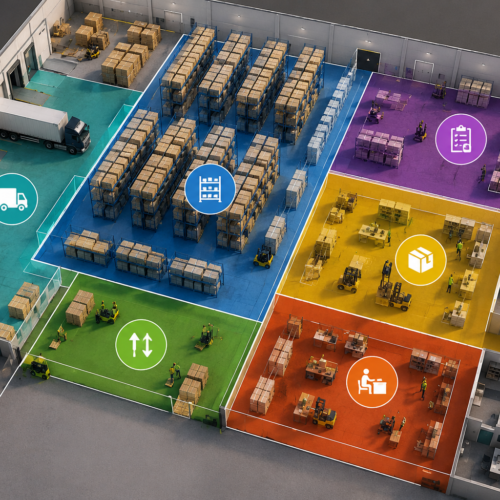
Warehouse Zoning: Efficient Space Planning
A warehouse can occupy thousands of square meters and still operate more slowly than a smaller facility if there is chaos inside. Proper space organization directly affects order processing speed, company costs, and employee convenience.

Dark Store: What It Is and How It Works
Online stores are growing, and customer expectations are rising with them. People are no longer willing to wait several days or tolerate mistakes in their orders.

How to Automate Order Picking for an Online Store
Order volumes are growing, and customer expectations are rising with them. While a small online store may once have managed with a few employees and simple inventory tracking, manual processes start slowing operations down as volumes increase.

Conducting a Warehouse Inventory: A Comprehensive Guide
Even a well-organized warehouse can gradually lose inventory accuracy if product movement is not monitored regularly. Receiving errors, stock mismatches, incorrect putaway, and losses during picking accumulate over time and affect not only system balances but also the company’s financial performance.
 Україна
 Great Britain
 Česká republika
 Қазақстан
 Deutschland
 Polska
 Oʻzbekiston
 Тоҷикистон
 España
 Argentina
 México
 Perú
Perú