Benefits of Implementing a WMS in a Warehouse
Effective warehouse management has a direct impact on order processing speed, service quality, and operational costs. Implementing a WMS helps companies systematically optimize warehouse processes and move from manual control to digital process management. This approach provides a wide range of operational benefits.
What Is a WMS and Why Is It Needed?
A WMS, or Warehouse Management System, is a specialized solution for automating warehouse logistics. It supports core warehouse processes, from goods receiving and putaway to order picking and shipment.
Unlike spreadsheets or basic ERP modules, a WMS is designed around real warehouse operations. It helps manage warehouse processes in real time, improves visibility across operations, and gives teams more control over inventory, tasks, and order fulfillment.
Key Benefits of Implementing a WMS
- Improved inventory accuracy — a WMS records every movement of goods, including receiving, relocation, picking, and shipment. This level of control reduces the impact of human error and lowers the risk of mistakes. It also helps prevent mis-sorting, reduce losses, and improve inventory visibility.
- Faster warehouse operations — implementing a WMS helps optimize employee routes and automate task assignment. The system shows where each item is located, builds efficient picking routes, and reduces order processing time. As a result, warehouse throughput increases without the need to expand the team proportionally.
- More efficient use of warehouse space — a WMS analyzes warehouse capacity and supports more efficient storage strategies. It can take into account product dimensions, turnover rates, and location-based storage rules. This reduces chaotic storage and helps place more goods within the same warehouse area.
- Real-time control and analytics — the effectiveness of WMS implementation is supported by real-time data across warehouse operations: order statuses, employee workload, and goods movement. Management gains the tools needed to make faster and more informed decisions.
- Lower operational costs — by automating warehouse processes, companies can reduce task execution time, decrease errors and returns, and optimize staff workload. This helps lower the cost of processing each order.
- Higher customer service quality — fast and accurate order processing directly affects customer satisfaction. A WMS helps shorten delivery times, reduce order errors and returns, and improve the reliability of order fulfillment. This is especially important for e-commerce, retail, and distribution businesses.
When WMS Implementation Becomes Especially Relevant
Implementing a WMS becomes particularly important when:
- the number of orders and SKUs is growing;
- warehouse space is expanding;
- inventory errors occur regularly;
- it becomes difficult to control employees and processes manually.
UIS WMS automates and optimizes key warehouse processes, from goods receiving to shipment. The system helps improve inventory accuracy up to 99.5%, reduce staffing needs by up to 30%, and increase warehouse capacity by 10–15%.
With handheld terminal support, real-time goods movement tracking, and an intuitive interface that allows employees to be trained in less than one hour, the system can be launched quickly and efficiently.
To learn more about implementation, timelines, and costs, contact our team. We will help select a solution that fits your warehouse operations.
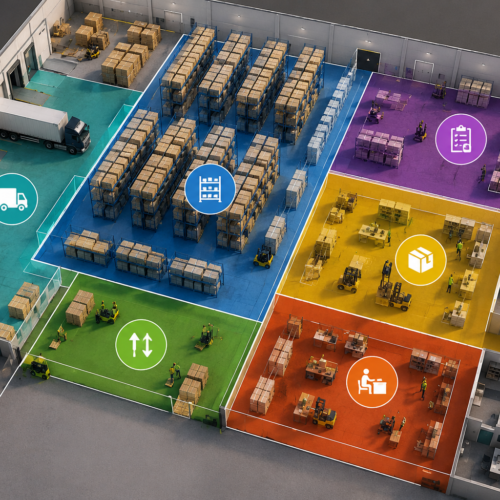
Warehouse Zoning: Efficient Space Planning
A warehouse can occupy thousands of square meters and still operate more slowly than a smaller facility if there is chaos inside. Proper space organization directly affects order processing speed, company costs, and employee convenience.

Dark Store: What It Is and How It Works
Online stores are growing, and customer expectations are rising with them. People are no longer willing to wait several days or tolerate mistakes in their orders.

How to Automate Order Picking for an Online Store
Order volumes are growing, and customer expectations are rising with them. While a small online store may once have managed with a few employees and simple inventory tracking, manual processes start slowing operations down as volumes increase.

Conducting a Warehouse Inventory: A Comprehensive Guide
Even a well-organized warehouse can gradually lose inventory accuracy if product movement is not monitored regularly. Receiving errors, stock mismatches, incorrect putaway, and losses during picking accumulate over time and affect not only system balances but also the company’s financial performance.
 Україна
 Great Britain
 Česká republika
 Қазақстан
 Deutschland
 Polska
 Oʻzbekiston
 Тоҷикистон
 España
 Argentina
 México
 Perú
Perú