How a Sorting Center Works
When someone clicks “place order,” they rarely think about the journey a parcel takes before it reaches their door or pickup point. It may seem as if the box simply travels to a postal facility, but in reality, fast delivery depends on a large system where everything must work in sync: scanners, conveyors, software, employees, and vehicles.
A sorting center is one of the key elements of modern logistics. This is where shipments are received, checked, sorted by destination, and transferred to the next stage of delivery. The speed of this facility directly affects whether an order arrives the next morning or is delayed for several days.
Today, a sorting center is no longer just a warehouse with belts and boxes. It is a technology-driven facility where most processes are automated. The larger the shipment flow, the more a business depends on the accuracy of software and equipment. That is why modern logistics complexes implement automated shipment management systems — solutions that help control cargo movement, reduce errors, and speed up order processing.
Where the Work of a Sorting Center Begins
Every parcel in a sorting center first goes through the receiving stage. Vehicles bring shipments from post offices, online store warehouses, or distribution hubs. Then boxes and packages are unloaded onto the processing line.
The first step is identification. The system reads the barcode, checks the route, delivery type, and shipment parameters. If the label is damaged or the data cannot be read, the parcel is directed to a separate manual processing area.
Speed is especially important at this stage. When tens of thousands of shipments pass through a facility every day, even a small delay can quickly turn into a queue. An automated sorting center helps minimize the number of operations performed manually.
Why Parcels Are Weighed and Measured
After scanning, shipments go through parameter control. Special sensors automatically measure dimensions and weight. This is needed for several reasons:
- logistics teams calculate transportation costs and optimal vehicle loading;
- the system determines which line the box should move along next;
- oversized cargo is processed separately from small packages.
In the past, these operations were performed by employees using measuring tapes and scales. Today, this work is done by automated dimensioning and weighing stations, such as the METRIX system. In just a few seconds, it records shipment parameters and transfers the data to the WMS system that manages warehouse processes.
UIS implements such solutions to help logistics centers speed up shipment processing without increasing the workload on staff.
How Sorting Works
The main task of a sorting center is to quickly distribute the flow by destination. For this, companies use sorting lines and automated sorters.
The principle is quite simple: the software receives route data, after which the parcel is automatically directed to the required sector. One container may be formed for a specific city, another for a separate branch or courier route.
When the flow is small, employees can still sort manually. But in large logistics hubs, automation is no longer optional. A modern sorting facility processes thousands of shipments per hour, and a person simply cannot maintain that speed without errors.
This is where the first bottlenecks appear. If the conveyor runs slower than the incoming flow or the system distributes routes incorrectly, queues can begin to grow within just a few hours.
Where Logistics Most Often Loses Speed
One of the main problems is uneven workload. On a regular day, operations may be stable, but during sales periods or holidays, shipment volumes can increase several times over.
If processes are poorly synchronized, delays appear:
- some shipments are not scanned in time;
- vehicles arrive before batches are ready for loading;
- employees spend time on manual checks;
- lines become overloaded during peak hours.
To avoid such situations, logistics companies implement integrated UIS solutions:
- WMS controls movement inside the warehouse;
- TMS manages transport operations;
- METRIX helps analyze workload and detect problem areas in real time;
- TiltTray and Switch Sorters automatically distribute shipment flows by destination without staff involvement.
These tools are used in UIS projects to automate logistics processes and increase throughput, turning a modern postal sorting center into a technology platform rather than a traditional warehouse.
How a Parcel Moves to Delivery
After sorting, shipments are distributed into containers and loaded into transport. What happens next depends on the delivery type: some shipments move to other cities, while others go directly to local routes.
At the final stage, the software checks the data again:
- whether the destination matches;
- whether there are any labeling errors;
- whether the vehicle has been loaded correctly.
Only after that does the vehicle move further along the logistics chain.
Today, delivery speed depends less on distance and more on how efficiently sorting is organized. The fewer manual operations, errors, and delays there are, the faster the parcel reaches the recipient.
Modern logistics is no longer just about moving boxes. It is the precise work of technology, analytics, and automation, where every second directly affects service quality.
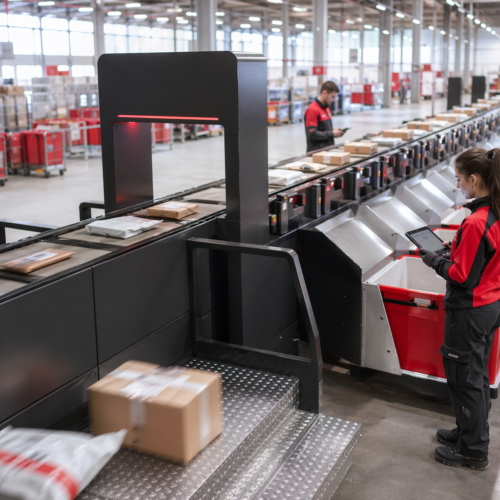
Sorting Systems for Postal Operators
Modern postal and courier services process thousands, and sometimes millions, of shipments every day. Under these conditions, parcel sorting becomes a critical stage of the logistics chain.
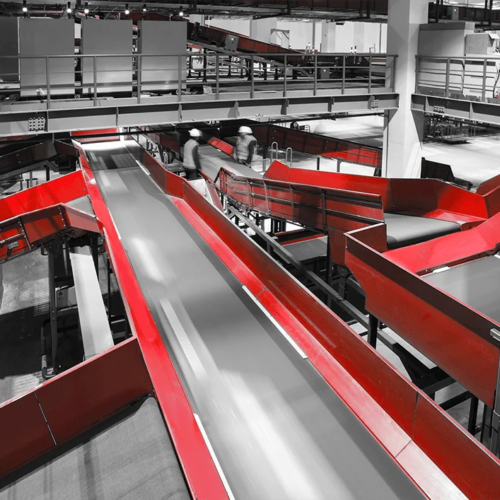
How a belt conveyor works
Moving goods from point A to point B at a constant speed without human intervention at any stage is a task that can be easily accomplished using a belt conveyor. It is a simple, continuous-action conveying device.
 Україна
 Great Britain
 Česká republika
 Қазақстан
 Deutschland
 Polska
 Oʻzbekiston
 Тоҷикистон
 España
 Argentina
 México
 Perú
Perú