How a belt conveyor works
Moving goods from point A to point B at a constant speed without human intervention at any stage is a task that can be easily accomplished using a belt conveyor. It is a simple, continuous-action conveying device.
Purpose and Design of Belt Conveyors
What are the components of a belt conveyor? The design of a belt conveyor includes a flexible belt, a drive drum and a tension drum, guides, rollers, a frame, a motor, and a control system. These conveyors come in horizontal, inclined, variable-angle, Z-shaped, and combined configurations—the choice of design depends on the intended purpose, installation location, and type of goods. Modern conveyors are automated, which maximizes their operational efficiency:
- Loading – Goods are placed one by one onto the moving belt (manually, mechanically, or automatically).
- Transportation – The goods move along with the belt. The items are held in place on the belt by friction; for transport on an incline, this friction must be sufficiently strong.
- Effect of retaining elements (on inclines) – on inclined conveyors, special crossbars or ribs may be placed on the belt; these also prevent the cargo from “sliding off.”
- Passage over rollers or supports that redistribute the load on the belt.
- At the end of the line, unloading occurs—the load slides off the belt and into a chute, trough, box, or onto the next conveyor section.
- The belt returns to the start of the route.
UIS develops and assists in the implementation of comprehensive logistics automation solutions, including high-performance automated conveyor sorting systems.
UIS Belt Conveyors
We provide comprehensive solutions for shipping goods along your chosen route:
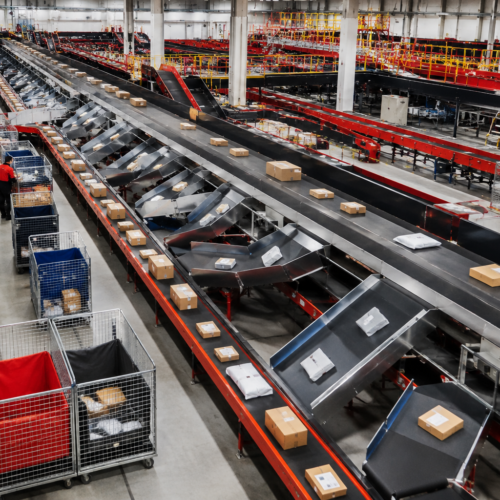
- Switch Sorter – an automated sorting system for large-sized packages weighing up to 30 kg.
- TiltTray Sorter – a sorting system for small packages weighing up to 10 kg, based on the “tilting tray” principle.
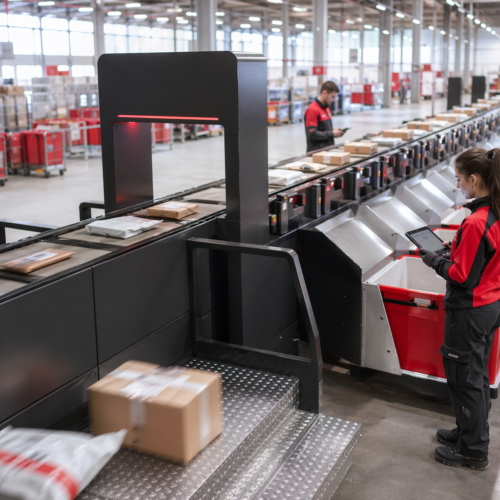
In UIS conveyor systems, goods move continuously along the belt sorting line. During this process, a scanner reads the product’s label and transmits the information to the system. The system then determines which output chute to direct the product to. At the appropriate moment, the discharge mechanism is activated, and the product is sent to the correct output path. The goods are then handed over to an operator, placed into packaging, or sent to the next conveyor section. All operations are recorded by the system—the goods’ destination, dispatch time, identifiers, and description. This ensures control over the goods and enables analysis of inventory turnover. This belt conveyor design offers a number of advantages:
- Cargo is processed at high speed, and sorting takes place while the conveyor is in motion, eliminating the need to stop it.
- Routes are flexible, and sorting channels can be reconfigured depending on current tasks.
- UIS systems are designed with a modular approach, making it easy to adapt and expand the lines.
- Thanks to automatic code reading and system control, the risk of errors is virtually eliminated.
UIS sorting systems can be integrated with WMS, OMS, and TMS to create a unified logistics solution.
How to Choose a Belt Conveyor
When designing a belt and sorting conveyor system, it is important to consider the following:
- Maximum load weight and dimensions – all components of the belt conveyor must be able to withstand the load.
- Conveyor speed – high speeds require precise adjustment of the drive, tension, and control systems.
- Sorting angle and deflection angle – these must not cause the load to slip during movement or redirection.
- Synchronization with the logistics system – sorting data must be integrated into the overall WMS and OMS systems.
- Estimated number of packages per day – the daily sorting volume must be taken into account to ensure uninterrupted operation.
We develop projects that can be customized for each client, complete with on-site technical support and maintenance services.
How a Sorting Center Works
When someone clicks “place order,” they rarely think about the journey a parcel takes before it reaches their door or pickup point. It may seem as if the box simply travels to a postal facility, but in reality, fast delivery depends on a large system where everything must work in sync: scanners, conveyors, software, employees, and vehicles.
Sorting Systems for Postal Operators
Modern postal and courier services process thousands, and sometimes millions, of shipments every day. Under these conditions, parcel sorting becomes a critical stage of the logistics chain.
 Україна
 Great Britain
 Česká republika
 Қазақстан
 Deutschland
 Polska
 Oʻzbekiston
 Тоҷикистон
 España
 Argentina
 México
 Perú
Perú