Sorting Systems for Postal Operators
Modern postal and courier services process thousands, and sometimes millions, of shipments every day. Under these conditions, parcel sorting becomes a critical stage of the logistics chain. It directly affects delivery speed, sorting accuracy, and service quality.
Parcel Sorting as the Foundation of Efficient Logistics
Parcel sorting is the process of distributing shipments by delivery destination: cities, regions, branches, or courier routes. Sorting postal shipments usually includes several key stages:
- receiving and registering parcels;
- identification using a barcode, QR code, or RFID tag;
- distribution by destination;
- preparation for further transportation.
The efficiency of this process affects the performance of the entire logistics system.
How Parcel Sorting Works
A modern sorting center usually follows a clear operational flow.
Shipment Receiving
Parcels arrive at a warehouse or sorting hub, where each item is assigned a unique identifier.
Scanning and Recognition
The system reads a barcode or automatically recognizes the address using OCR technology.
Analysis and Routing
The software determines where the parcel should be sent based on the address and logistics rules.
Physical Sorting
The parcel moves along a conveyor or through a robotic system to the correct chute, bin, or destination.
Consolidation and Dispatch
Shipments are grouped by route and transferred to the next stage of delivery.
Main Types of Sorting Systems
Different sorting solutions are used depending on business scale and shipment volumes.
- Manual sorting is used in smaller warehouses. It requires lower implementation costs but creates a strong dependence on staff and increases the risk of errors.
- Semi-automated systems combine manual work with technology. Conveyors and scanners speed up shipment processing and reduce the workload on employees.
- Automated sorting systems are the modern standard for large postal and logistics operators. They include high-speed conveyors, automatic distribution, integration with WMS and TMS, and reduced dependence on manual work. Such systems can process tens of thousands of shipments per hour.
Benefits of Automated Sorting
Automated sorting of postal shipments provides clear business advantages:
- Processing speed — significantly reduces sorting time;
- Accuracy — lowers the number of distribution errors;
- Scalability — supports growing shipment volumes;
- Process visibility — enables real-time tracking of each parcel;
- Cost reduction — helps optimize staffing and workload distribution.
The Role of Technology in Parcel Sorting
Modern sorting systems use:
- machine vision for address recognition;
- IoT devices for movement tracking;
- software algorithms for route optimization;
- analytics to improve operational efficiency.
As a result, parcel sorting becomes faster, more accurate, and less dependent on the human factor.
When a Business Needs Sorting Automation
Businesses should consider implementing sorting systems when:
- shipment volumes are growing;
- delivery geography is expanding;
- manual sorting errors occur regularly;
- order processing needs to be accelerated.
Parcel sorting is a critical process for postal operators and logistics companies. Automation in this area helps speed up shipment processing, reduce errors, and scale operations without a proportional increase in manual labor. That is why sorting systems are becoming one of the key factors of competitiveness and sustainable growth.
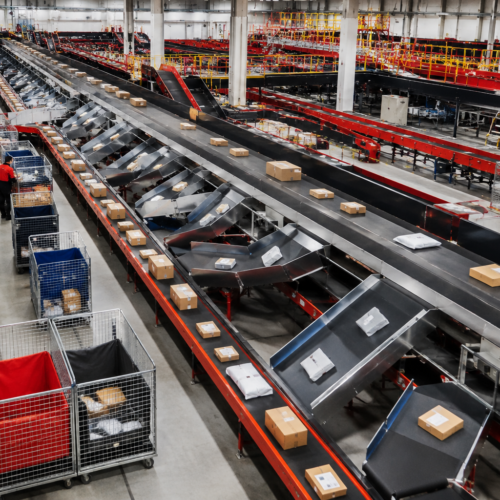
How a Sorting Center Works
When someone clicks “place order,” they rarely think about the journey a parcel takes before it reaches their door or pickup point. It may seem as if the box simply travels to a postal facility, but in reality, fast delivery depends on a large system where everything must work in sync: scanners, conveyors, software, employees, and vehicles.
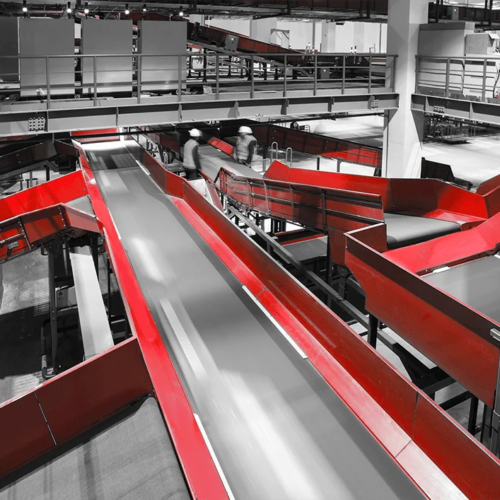
How a belt conveyor works
Moving goods from point A to point B at a constant speed without human intervention at any stage is a task that can be easily accomplished using a belt conveyor. It is a simple, continuous-action conveying device.
 Україна
 Great Britain
 Česká republika
 Қазақстан
 Deutschland
 Polska
 Oʻzbekiston
 Тоҷикистон
 España
 Argentina
 México
 Perú
Perú