What is location-based storage in a warehouse?
A modern warehouse is no longer just a place to store goods. Today, it is a structured system with well-defined processes, where every operation affects the overall outcome. As volumes grow and demands for faster order processing increase, more and more companies are adopting location-based storage.
Location-based storage is an approach in which each item or product group is assigned to a specific storage bin. This makes it easy to identify the exact location of any product at any time, streamlines warehouse processes, and reduces the risk of errors. Operations become more stable and predictable.
Location-based storage is especially useful for companies with a wide product range and high inventory turnover. This approach simplifies inventory control, reduces shipping errors, and improves overall logistics efficiency.
Location-based warehouse storage: how it works
The system works by dividing warehouse space into zones, aisles, racks, and bins. Each bin is assigned a unique address, which is recorded in the inventory system. When goods arrive at the warehouse, they are assigned a specific storage location.
A warehouse that uses location-based storage eliminates random product placement. Employees do not have to rely on memory to find goods but follow a specific address; this is especially important with large volumes, when manual navigation becomes inefficient.
In practice, location-based storage becomes the foundation of efficient warehouse operations, allowing you to:
- track the movement of goods;
- monitor inventory levels;
- speed up order fulfillment operations.
At the same time, location data is always up-to-date when an automated management system is used.
Location-Based Storage: Setup and Benefits
Setting up such a system requires preparation. It is necessary to:
- plan the layout of the zones;
- define placement rules;
- implement an inventory tracking system.
When properly configured, this approach offers significant advantages:
- order picking and fulfillment become faster;
- the number of shipping errors is reduced;
- inventory visibility improves;
- warehouse space is used more efficiently;
- staff training is simplified.
Additionally, it is important to establish uniform operating standards for employees and regularly verify compliance with established rules to avoid confusion when moving products and to maintain order in work processes. Over time, the system begins to operate smoothly, and all operations are performed faster and with fewer resources.
The Role of Automation in Location-Based Storage
This approach works best when supported by digital tools. Without automation, it becomes difficult to keep data up to date and track the movement of goods.
Ukrainian Intelligent Systems (UIS) implements a warehouse management system (WMS) that makes location-based storage practical and scalable. Solutions from UIS provide:
- precise distribution of goods across storage bins;
- control over operations;
- real-time access to information.
UIS products enable businesses to process orders faster, reduce costs, and improve customer service quality.
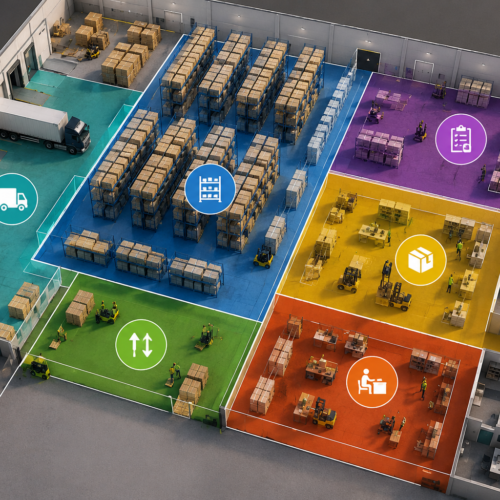
Warehouse Zoning: Efficient Space Planning
A warehouse can occupy thousands of square meters and still operate more slowly than a smaller facility if there is chaos inside. Proper space organization directly affects order processing speed, company costs, and employee convenience.
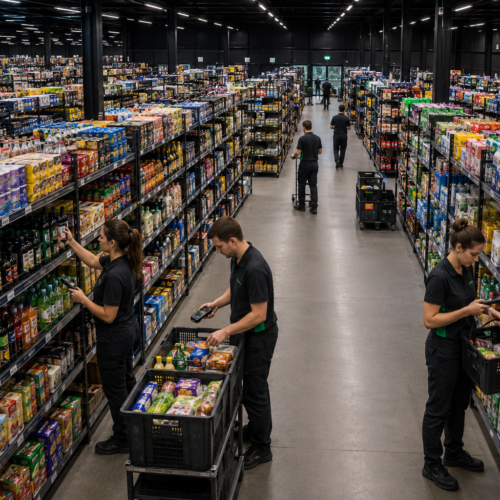
Dark Store: What It Is and How It Works
Online stores are growing, and customer expectations are rising with them. People are no longer willing to wait several days or tolerate mistakes in their orders.

How to Automate Order Picking for an Online Store
Order volumes are growing, and customer expectations are rising with them. While a small online store may once have managed with a few employees and simple inventory tracking, manual processes start slowing operations down as volumes increase.

Conducting a Warehouse Inventory: A Comprehensive Guide
Even a well-organized warehouse can gradually lose inventory accuracy if product movement is not monitored regularly. Receiving errors, stock mismatches, incorrect putaway, and losses during picking accumulate over time and affect not only system balances but also the company’s financial performance.
 Україна
 Great Britain
 Česká republika
 Қазақстан
 Deutschland
 Polska
 Oʻzbekiston
 Тоҷикистон
 España
 Argentina
 México
 Perú
Perú