Warehouse accounting: automation and control
In any retail, manufacturing, or distribution business, inventory management is one of the key links in the supply chain. Much depends on how accurately and precisely inventory is tracked:
- efficiency of warehouse operations;
- minimization of losses;
- order processing speed;
- level of customer service.
How to Properly Track Inventory
As business grows, manual inventory management (on paper, in Excel, etc.) becomes impractical. Companies that implement automation processes gain a competitive edge. These processes help organize inventory management as efficiently as possible across all areas:
- Goods Receiving – Verifying that delivered goods match the delivery notes, checking the registration of goods, their quantity, and quality.
- Storing – Assigning storage locations (bins, shelves), moving goods within the warehouse.
- Inventory and stock control – verifying the actual presence and quantity of goods in the warehouse, identifying misclassifications and shortages.
- Movement between zones – moving goods within the company (for example, between storage zones).
- Order picking and assembly.
- Shipping and forwarding – preparing shipping documents, verifying compliance, and shipping.
- Returns, restocking, and re-inventory.
- Reporting and sales analytics.
Why automation is a step forward
Automating warehouse inventory management minimizes the risk of errors (barcodes are scanned automatically, and operations are monitored by the system). Every transaction is recorded and can be viewed in reports, ensuring transparency in business operations. Receiving, picking, and movement processes are accelerated and optimized. Inventory of goods and materials is distributed more efficiently across storage bins, thereby saving space in warehouses. The system can handle volume growth, warehouse expansion within the enterprise, and multi-warehouse architecture; it integrates with other systems—ERP, TMS, OMS, and others.
But it is important to know that automation without proper control can be dangerous: a system without audits and checkpoints can lead to errors. Control is mandatory and represents the next level after automation, helping to perform verification, validation, recounts, and more.
Components of an automated warehouse
Automation involves a system comprising software, hardware, and procedures, including:
- WMS (Warehouse Management System).
- Data collection terminals (DCTs, barcode/QR/RFID scanners).
- Barcode and RFID label printers.
- Mechanized systems and automation: conveyors, sorters, “pick-by-light,” “put-to-light,” and automated sorting systems.
- Measurement systems (weight and volume).
- Integration with external systems—ERP, TMS, OMS, accounting systems, CRM.
- Control and audit modules.
- Control panels, dashboards, notifications, alerts.
The goal is to ensure that all components operate in sync to produce reliable data.
UIS Products for Warehouse Management and Logistics
UIS.WMS is a warehouse management system that covers all stages of operations—receiving, issuing, transfers, picking, and shipping. It automates the process of creating storage bins, allows data entry via mobile devices, and documents each item by scanning barcodes or QR codes. It integrates with ERP, TMS, OMS, and other systems within the company’s IT ecosystem. It is an effective tool for reducing errors and ensuring compliance, easily monitoring inventory levels, and accelerating order processing.
UIS Pick by Light – a hardware and software solution designed to accelerate and simplify the order picking (assembly) process:
- The use of LED indicators on the bins that illuminate the correct items for picking and confirm the pick.
- Speeds up order picking by up to 50% compared to manual picking.
- Minimizes the risk of errors—the worker can immediately see which items to pick. Each item picked must be confirmed.
- Works both as a standalone solution and integrated with WMS.
To help you manage your inventory and optimize your logistics, we also offer the following products:
- UIS.TiltTray Sorter / Switch Sorter – simplifies warehouse inventory management and automates the sorting process for small and large shipments.
- UIS.METRIX – a system for measuring the weight and volume of parcels, automatically transmits parcel parameters to the system.
- UIS.PostOffice – warehouse accounting software, used to automate operations at post offices and order pickup points.
- UIS.TMS – a courier delivery management system.
- UIS.HUB – management of long-haul transportation, transport monitoring and tracking, GPS integration, and routing.
- UIS.OMS – a comprehensive order management system.
If you want to streamline your warehouse inventory management process, you need to automate it effectively. With solutions from UIS, this is much easier to achieve. When you purchase our products and software, you receive detailed implementation guidelines and expert support throughout your entire partnership with UIS.
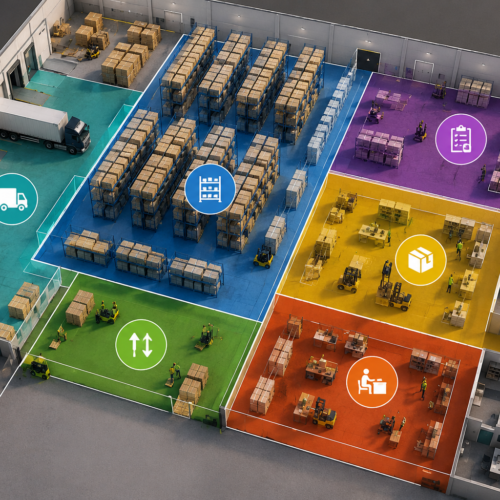
Warehouse Zoning: Efficient Space Planning
A warehouse can occupy thousands of square meters and still operate more slowly than a smaller facility if there is chaos inside. Proper space organization directly affects order processing speed, company costs, and employee convenience.
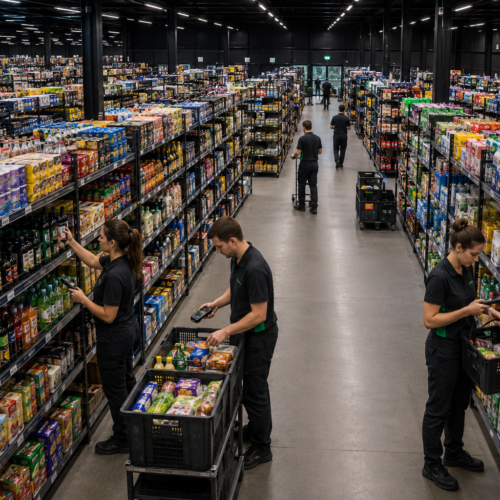
Dark Store: What It Is and How It Works
Online stores are growing, and customer expectations are rising with them. People are no longer willing to wait several days or tolerate mistakes in their orders.

How to Automate Order Picking for an Online Store
Order volumes are growing, and customer expectations are rising with them. While a small online store may once have managed with a few employees and simple inventory tracking, manual processes start slowing operations down as volumes increase.

Conducting a Warehouse Inventory: A Comprehensive Guide
Even a well-organized warehouse can gradually lose inventory accuracy if product movement is not monitored regularly. Receiving errors, stock mismatches, incorrect putaway, and losses during picking accumulate over time and affect not only system balances but also the company’s financial performance.
 Україна
 Great Britain
 Česká republika
 Қазақстан
 Deutschland
 Polska
 Oʻzbekiston
 Тоҷикистон
 España
 Argentina
 México
 Perú
Perú